February 8, 2015

Lessons from a family funeral

PART 1: THE NEWS

It's been awhile since I've had a chance to blog. Four months to be exact. I have written dozens of posts in my head since then. Topics run through my mind as I'm walking, driving or folding laundry but evaporate quickly, as I don't have the time to write them down because I lack two crucial ingredients: peace and quiet.

It is harder with the second child. Somehow when it was just one, I still felt like I could juggle everything. I could pass off Owen to Dave when I needed to work late, balance the checkbook, go to yoga, or have phone conversations that lasted longer than five minutes. Now, with two of them, getting everyone out of the house with shoes on, jackets zipped and the diaper bag packed feels like it takes an act of Congress, as British comedian Michael McIntyre so brilliantly illustrates in this sketch.

Tonight I have some peace and quiet, nine hours to be exact, as I'm on a plane thousands of miles above the earth on my way to Munich to attend a business conference. I've never been so excited about a transatlantic flight, as I typically prefer the destination to the journey. Tonight it feels luxurious to sit alone in the dark with only the glow of my laptop to keep me company. Finally I have time to sit, reflect and think about my grandma, who died a few weeks ago, 18 days shy of her 97th birthday.

When my mom called from Los Angeles to tell me Grandma had passed away, it was 9 a.m. in Chicago. I was in the throes of shoving work papers into my bag, finding socks for Owen and slamming coffee so I could get him to preschool and myself downtown to my office. The first time I saw my mom's number light up on my phone, I didn't answer. But then she didn't leave a message, which is unusual. And she never calls that early. So when she called back the second time, I picked up.

"Laurie?" Mom said. 

"Yes?"

"Your Grandma Green died last night," she said. "She went to the hospital for a kidney issue and didn't make it."

I stopped shoving things into my bag and looking for socks for Owen. It had been a long time coming, given her age and health issues. Yet the news that she was gone, really gone, still came as a shock.

"Oh," I said.

PART 2: THE GRANDMA I KNEW

Margaret Green was my last living grandparent, most of whom lived into their 90s. She grew up in Baton Rouge and brought a Southern flavor to grandmothering. "Come here and give me some sugar," she would say with a slight drawl, her arms outstretched to pull me into a fierce hug. She called black people "coloreds," no matter how often Eric and I corrected her and she was forever busy perfecting her role as a 1950s housewife, whether it was wallpapering, cross-stitching or cooking a big pan of homemade Mac 'n cheese — Eric's and my favorite.

Margaret Carter Green
She poured us glass after glass of "purple juice" (grape) and kept a stock of Vanilla Wafers in a cabinet above the stove that I used to scale the counter to get to. She also stashed Doublemint gum and butterscotch candies in a kitchen drawer I would raid during visits to her house on Havana Avenue, whose rooms I knew as well as those in my own childhood home.

Even now, I can picture the back patio where she and Grandpa used to relax with rum and cokes during summer afternoons, the screened back door that thwacked behind you as you entered the kitchen, and the den where Grandpa would sit playing solitaire, turning cards over three at a time, hour after hour, while watching golf on TV, a pastime I found incredibly boring.  

I remember the long table in the dining room where we gathered for holiday dinners that we were never allowed to start eating until Grandma took her seat at the head of the table, picked up her fork, peered at our faces and asked, "Is everybody happy?"

I remember the staircase that led to the second floor, where the first stop was the bathroom where Grandpa used to hack himself awake every morning, the result of emphysema caused by a smoking habit he had acquired as a Navy officer during World War II.

Past the bathroom was the guest room with floral wallpaper, lace curtains and black-and-white headshots of my grandparents' four children in oval frames along the wall (my mom was third in the lineup). That's where I used to sleep when I stayed over, my grandma stroking my eyelids to soothe me to sleep when she tucked me in tight at bedtime.  

My grandparent's house on Havana Avenue
Across the hall from the guest room was my grandparents' room, with two twin beds pushed together, Grandma's closet overflowing with shoes, freshly pressed slacks and silky dresses and blouses (she loved to shop, to say the least) and a sitting room where they kept one of those inversion therapy contraptions popular in the 1980s for relieving back pain.

The contraption looked like a flat, vertical lawn chair that you strapped yourself into and leaned backwards to turn upside down. Eric and I were too young to suffer back pain, but that didn't stop us from flipping upside down and watching each other's faces turn beet red, giggling as our toes tingled. (For a visual of a modern-day version, go here.)

This is all to say that my memories of my grandma are fond ones, and as I sank into my seat on the El after dropping Owen off at school the morning Mom called with the news, I felt my eyes well up with tears. I quickly brushed them away, afraid that my fellow commuters would see them. I didn't have time for this. I had a huge deadline at work. I could cry about this later. Come on Laurie, compartmentalize. But the memories kept coming.

PART 3: THE LESSONS

I wasn't just crying because I loved Grandma and would miss the special bond we shared. She was the one who was convinced I'd become a writer, no matter how much I dappled in other careers and screwed around after college. "You were a favorite," one of Grandma's cousins whispered to me at Grandma's funeral, clutching my hand from her wheelchair and pulling me close so I could hear her.

Grandma, age 1 
I was also crying because in many ways, my grandma was a tragic figure. She was a wonderful grandma, everything I could have ever wanted. But as a mother she had shortcomings that she never seemed able to overcome. I attribute those shortcomings to a lack of nurturing that she suffered as a child, the heavy dose of Southern Baptism that was heaped upon her, insecurities about growing up working class and a general lack of self awareness common among her generation.

Yet no matter the cause, she had been estranged from all three of her living children at one period or another, particularly my mother. Just months before she died, Grandma turned to my sister-in-law, Sonnet, at Thanksgiving and asked, in her halted speech belabored by a series of strokes, "Why…does…Marty…hate…me…so…much?"

So as I sat at Grandma's funeral, with Sarah McLachlan's "I Will Remember You" playing as attendees dabbed their eyes with tissue and gazed at Grandma's portrait, I reflected on her life, her struggles and the lessons I could learn from them.

What I'm about to say is not meant to tarnish her reputation or minimize her many positive qualities, as I have great compassion for my grandma. I write this as a daughter who often struggles to accept my own parents, and as a parent whose greatest desire is to stop the legacy of pain that seems to pass down from generation to generation, albeit in different forms and flavors. 

Lesson 1: Don't play favorites.

Born in 1918, Grandma was the oldest of two girls. During her funeral, her younger sister Florence, now 94, stood up and tried to explain why she and Grandma had been staunch rivals throughout their lives. There was so much animosity between the two sisters that they didn't speak for decades, and their children (my mom and her three siblings) and Florence's seven children didn't grow up playing together or sharing holidays, despite living in the same city of Long Beach, California.

Grandma and Florence
It wasn't until my grandpa died in 1996 that Florence and Grandma reconciled, realizing that their issues were largely orchestrated by their parents. Grandma had been her father's favorite, a daddy's girl. So when Florence came along, their mother, Lillie, worried that he wasn't giving Florence enough love and attention. She compensated by favoring Florence and becoming highly critical of Grandma. Competition and bitterness between the sisters ensued. So did Grandma's lifelong feud with her mother.

My grandma then perpetuated that bias by aching for a son. She had three daughters, one after another, and was convinced it was punishment for some sin she had committed (remember, she grew up Southern Baptist). So when my Uncle Charlie was finally born, it was cause for great celebration. My mom, being the third girl, suffered the brunt of it.

Mom remembers, for example, begging her parents for a car because they had moved across town when she was a senior in high school and she would have to ask friends to give her rides to school and the many activities she was involved in. The answer was no. A few years later, when Charlie turned 16, my grandparents told him they would buy him a car if he maintained a C average (my mom was a straight-A student). Even when he failed to make his grades, he got a car anyway.

I realize this double standard was common back then and in many ways, continues today. But I can't emphasize enough how damaging it is for parents to fan the flames of jealousy among their children, pitting them against each other with favoritism and unequal treatment.

Lesson 2: Stand by your children.

One of the most painful things Grandma had to do in her life was turn over custody of her firstborn child, Joanny, to the state of California. Since Joanny had been born, there was clearly something wrong. At 2 months old, she started having five to six seizures a day, for reasons the doctors had difficulty discerning.

As the seizures continued, Joanny became more mentally disabled. My Aunt Janet remembers Joanny spending hours rocking back and forth while watching TV at their grandparents' house. In the grainy black-and-white family videos I've seen, Joanny marches back and forth in front of their childhood home like a soldier, expressionless. My mom, a toddler, plays with dolls on the front lawn nearby.

Joanny, Marty (my mom), Charlie and Janet
By the time Joanny was nine, my grandma was struggling to care for three other children. Janet was 6, my mom 5 and Charlie was less than a year old. Joanny became too much for her to handle so she and Grandpa decided to have her committed to a children's hospital, which meant turning over custody to the state.

This being 1950, there were few options for parents with disabled or troubled children. But Grandma's parents never forgave her. As good Southerners who believed in taking care of their own, they thought it unconscionable that a mother would give up her own child. They stopped speaking to Grandma and cut off contact with their grandchildren, even though they lived next door.

"Wait, so since you were six years old, you were never allowed to go over to your grandparents' house again?" I recently asked Aunt Janet.

"Yes, sometimes we could hear our cousins playing in their yard but we couldn't go see them," Janet said. "Doris and Frank would come to our front door to ask if we could play, but Mom would say no."

"How long did you live next door to your grandparents after they stopped speaking to you?" I asked.

"Mom and Dad moved to the Havana house when I was in college and Marty was a senior in high school," Janet said. "So it must have been 15 years."

"Fifteen years!" I said. "Why didn't you move away earlier?"

"Housing was difficult to come by back then," Janet said. "You couldn't move around like you can now."

"Wow," I said. "Even if Lillie and Ollie disowned Grandma, I'm surprised they ignored their own grandchildren."

"I know," Janet said. "They did give me and Marty electric typewriters when we graduated from high school."

Ouch.

Joanny died of kidney failure in the children's state hospital at age 16. Before Joanny's death, my mom remembers visiting her with the family and taking her out for picnics on weekends. Yet I don't think Grandma ever got over having a "defective" child or the shame that was compounded by her parents' harsh reaction to her difficult decision to give up custody.

Lesson 3: Do not remain friends with your children's exes.

This was the fatal mistake that Grandma made with my mom, and the reason that Mom ultimately cut off contact with her around the time I graduated from college. The tension started when my parents separated when I was 10 and Eric was 7. My grandma sided with my dad, even though she and Mom had seemed close and we saw our grandparents often, as they lived just 20 miles away.

My mom says Grandma told her things like, "I know how difficult you are to live with." And even before my mom filed for divorce, whenever she appealed to Grandma for support about their marital conflicts, Grandma's advice amounted to, "Boys will be boys" and "You have a lovely home, a nice station wagon and two beautiful children in private school. Go clean out the refrigerator."

After Mom filed for divorce, my dad fought for sole custody, a move that shocked my mom because she had always been our primary caretaker while Dad focused on his career (my mom will tell you ad nauseam how he never changed a diaper, gave us baths or read us bedtime stories). Throughout the custody battle, Grandma seemed to side with Dad. Why did she do this?

Grandma and her "Berkeley man"
Here's my best assessment, based on what I know now and what I remember from a period that was disorienting to say the least, when it felt like the world had turned upside down and the adults I depended on suddenly went insane. Things I took for granted, like the fact that I was safe, that my parents would protect me and had my best interests in mind, seemed uncertain because they were so engaged in warfare with each other.

We were all living in this alternate universe of hurt, fear, anger and confusion and I think Grandma got swept up in it. She had always liked and admired my dad, a handsome, charming, ambitious dentist who fit the mold of the type of man she would love her daughters to marry. Because of her humble upbringing as the daughter of a restaurant owner who never went to high school, Grandma had always been in awe of status and determined to move up the social ladder.

Marrying my grandpa, a "Berkeley man" who came from a wealthy family, helped. So did the many junior leagues, charity groups and committees she joined, as well as her trips abroad, expensive jewelry and the shiny gadgets she loved to acquire. Having a son-in-law who was a doctor only completed the picture.

My mom was the opposite. She was an introvert, more practical and fiscally responsible. She was smart and beautiful, but also a homebody who wasn't big on parties and pomp and circumstance. Until the divorce, I think Grandma and Mom got along well enough as mother and daughter, but it was a tenuous bond, given their personality differences. So when crisis struck, Grandma gravitated towards Dad. Despite the circumstances, I don't think she wanted Mom to divorce him.

My parents, 1967
Throughout the divorce proceedings and for years afterward, Grandma and Dad maintained their friendship. Grandma and Grandpa would go out to dinner with Dad and his new wife, Suzi, and spend holidays with us at Dad's house. They still saw my mom, yet whenever they got together, Mom says Grandma would talk incessantly about Dad and what he and Suzi were up to. When mom asked her to stop, Grandma responded by saying, "I always have to walk on eggshells with you."

Years later, I asked Grandma why she turned away from her daughter at such a critical time, when she was in so much pain over her troubled marriage, facing the prospect of going back to work to support two young children and getting hit with criticism on all sides from my Dad, his parents and her own parents for breaking up the family.

We were sitting on the floor in my Grandma's bedroom in her oceanfront high-rise that she had moved into after Grandpa died. I had just finished reading some letters that had fallen onto the floor when I was getting something down for her from the top shelf of her closet.

The letters were from my dad and his father to my mom, basically pleading with her to reconsider "for the sake of the children." Reading the letters, I had a visceral sense of Mom being ganged up on. I felt the heat of anger in my chest as I realized the extent to which her own mother had failed to support her.

"She was hurting and alone," I said. "You betrayed her."

"It was a different time then," Grandma said, barely meeting my eyes. "And I was afraid of losing access to you kids."

"Us kids?" I said. "How would you lose access to us? Mom got joint custody. You could have seen us at her house."

Our family in 1981, two years before the divorce
Grandma sighed and didn't answer. It didn't make any sense. A lot of things didn't back then.

So here's what I've learned from this one. When your child, no matter how old, breaks up with a boyfriend, girlfriend or spouse, don't stay friends with the ex. Don't call them on the phone, go out to dinner, visit them, or ask them to speak at your husband's funeral (Yes, Grandma asked Dad to say the eulogy at Grandpa's funeral). 

I don't care how much you've shared over the years or how much you like them. This is someone who hurt your child, sometimes deeply. You need to get that. And respect it, no matter how messy the circumstances. It's called loyalty.

Sure, be cordial if you see him or her at family gatherings, send a brief note if you hear they've suffered a death in the family. But unless your child and the ex are on extremely good terms, don't be too friendly. Just don't. Otherwise you risk wandering around for years wondering why your child doesn't speak to you anymore, no matter how many people try to explain it to you.

Lesson 4: You don't always know what's best for your children.

When my Aunt Janet and her college boyfriend came home to announce they were engaged, Grandma ran out the front door sobbing. Janet's boyfriend, Pete, was Catholic. This was apparently a big problem. Growing up Southern Baptist, Grandma wasn't allowed to play cards, go to dances or associate with the Catholic girls who lived across the street. These were difficult rules for Grandma, being a social butterfly, but her mother was insistent. Even though Grandma left Louisiana with her family when she was 14 to move to Arizona, then California, she apparently took her Catholic bias with her.

Prior to this outburst, Janet says she and Grandma got along well. She remembers coming home every day from school and sitting on a stool to watch Grandma make dinner while she recounted the events of her day. But once Janet announced her decision to marry Pete, that changed everything. Grandma stopped speaking to her and she later learned that Grandma had gone to Pete and told him that Janet had mental problems in an effort to dissuade him from marrying her.

Janet and Pete, 1967
Besides being Catholic, Pete wasn't flashy or gregarious, which probably didn't appeal to Grandma either. He was on the shy side, a salt-of-the-earth type of guy as solid as his big-boned German heritage with an understated, wry sense of humor. After he and Janet graduated from UCLA, he joined the military and they moved away to North Dakota and then Florida, where Pete became a high school English teacher who coached baseball and football in a small town outside of Jacksonville.

Over the years, Janet and Grandma reconciled, but it was a bumpy ride considering that Grandma viewed Janet's marriage as "Pete taking Janet away from me." When Pete and Janet had children, my cousins Erin and David, Grandma and Grandpa didn't make much effort to visit them, despite their many trips to Europe, Asia, and other far-flung places. That hurt Janet, who wanted her children to be close to their grandparents. In my mind, this was an extension of Grandma's inability to accept the person Janet had picked to share her life with.

But here's the thing about Pete. He was perfect for Janet. Of all the marriages in my family, theirs was probably the healthiest. Of course it wasn't perfect, whose is? Janet says when she could tell that Pete was mad at her, she would look at him and say, "Is it worth it?" And when they were both retired and at home all day together, they would go to separate ends of the house and do their own thing for a few days until the tension subsided.

All you had to do was spend a weekend with Pete and Janet to see that they honestly liked each other. Watching my parent's marriage dissolve into animosity and heartbreak, I was particularly sensitive to couples who seemed at ease with each other. I didn't spend much time with Pete and Janet growing up, as we lived in California and they lived in Florida. But later in my life, when I became a reporter, I visited them during the two years I worked for a newspaper in Miami.

During this time, Pete took an interest in my writing and used to send me emails praising my use of dialogue and description in my news stories. He became one of my biggest fans and most devoted readers, given our common appreciation of storytelling. In those emails, he would provide updates on what he and Janet were up to on Lake Asbury, referring to my aunt as "Old What's Her Name" and joking about how he couldn't get her away from her computer long enough to feed her anything, which was why she was so skinny.

My cousin, David, and Uncle Pete six months before he died  
When Pete died of cancer three years ago, I was pregnant with Owen and couldn't make it to his memorial. I'm sure I sent Janet a sympathy card, but I got so engrossed in my own life that she and I didn't have a chance to talk about the events leading up to Pete's death or how she'd been coping since then, until Grandma's funeral a few weeks ago.

She cried as she told me how much she missed him, and I cried right along with her, especially when she told me that after he had died, she found a document on their computer called, "Wisdom if any from Pete Campbell to his son."

It was a letter Pete had written to my cousin, David, when he knew that he was dying, a list of 12 life observations. Janet's voice caught in her throat as she told me one of them was, "Your mother was the best thing that ever happened to me."

I cried even harder when she told me that, thinking to myself, Can you imagine being the best thing that ever happened to someone? And I was so touched that this was something Pete was writing to his son, man to man. Janet later shared the letter with me, and I got to see that what Pete had said about Aunt Janet was even better, and wiser than the sentiment about how special she was to him. This is the full entry from wisdom item Number 6 of Pete's letter:  
Your mom has been the best thing in my life. But it was pure luck that we met and got along at first. Moral:  Don’t control or manipulate the spouse. The most amazing thing I’ve seen is how your mom has grown, changed, and become an even better companion through her own efforts—not mine.
Here are a few other of my favorites from Pete's letter:  
1. Giving and showing your children how to give is the most important gift to teach. The problem is every parent wants to give to his children rather than make them earn and appreciate it. You were lucky: we didn't have much money to spoil you. 

4. Troublesome bosses, relatives, associates all go away in time. Remain focused and ignore negative people. Most of the time you will get a better job that takes you away from problematic people. The rest of the time, they get fired. 

8. Hemingway said that courage is grace under pressure. The fewer excuses you make, the better you become at developing courage. I still make a lot of excuses but every time I deliberately say, "No excuse" to myself, I feel a little stronger.
Pete ends with this one, which beautifully sums up the importance of putting your biases aside and trusting your children's decisions. In his humble way, Pete demonstrates the grace with which he approached his children:  
12. Rereading these items, I realize you already know 90% of them. See what you can add. I’ll bet you have some incredible ideas. 
Lesson 5: People hurt you because they're hurting.

One of Grandma's many hobbies was genealogy. She would spent hours searching online and going to the library archives in various cities tracing her family's heritage, along with the lineage of Grandpa's family and my dad's relatives. I remember her printing out black-and-white photos on her ink jet printer of stout, fierce looking German women holding tiny baby bundles and explaining to me who they were and how they had come to America.

For the most part, I found Grandma's obsession with our ancestors tedious and grew tired of listening to her recount her latest findings. Being in high school at the time, I didn't see how these fierce looking German women had anything to do with whether I'd get a date to the prom or make the varsity soccer team.

Grandma and me, somewhere in my 20s
But one thing Grandma said during that time has always stuck with me. She said the mothers and daughters in our lineage had a long tradition of difficult, strained relationships with each other. It was certainly true of Grandma and her mother, and of her and my mother.

"You are going to be the one to break that pattern," Grandma told me.

I remember being surprised by that comment, as I was only 16 and having plenty of run-ins with Mom about curfew and whether I'd been drinking. How was someone like me, with ratted bangs, blue eyeliner and a compulsion for eating all the carbs in the house when no one was looking, going to change the course of history?

That was the thing about Grandma. She seemed clueless about so many things, oblivious to her many blind spots about how her actions contributed to the turmoil in her relationships, and yet she would make these declarations that demonstrated her unequivocal love, faith and confidence in me.

So here comes the hard part. How do I keep my parents, my spouse, my children and pretty much anyone in the soft focus that keeps resentment from building? How do I remember that when people are unkind, critical or clueless, that it's likely the result of their own pain or limitations, which have nothing to do with me? And how do I keep myself in that same soft focus while reminding myself, as Uncle Pete suggests, "No excuses"?

Therapy has helped, as has hours spent in 12-step meetings and holding out for the right person to marry after what my friend, Filip, refers to as my many years of "stupidly dating." (The good news: Filip, my parents and even Grandma approve of my husband, Dave, despite the fact he grew up Catholic.) 

Having children has also helped me develop greater compassion, as I understand first-hand what an imperfect science it is to raise them, how challenging it can be to fulfill their needs, and why my mom often looked so damn tired.

PART 4: THANK YOU, GRANDMA

I sometimes wonder what my life would have been like if my parents hadn't gotten divorced and upended my life at the tender age of 10 with joint custody, new partners and ongoing power struggles. Today I look at them and can't image how these two people fit together. Yet if they had managed to have some kind of workable union, would I still have developed an eating disorder? Struggled with depression and anxiety? Spent so many years stupidly dating?  

Along those same lines, what would Grandma's life had been like if her mother had been kinder? Joanny had been healthy? Her parents hadn't disowned her? Would she had been better equipped to support her daughters' choices? Love and understand them? Recognize her shortcomings? Take constructive action?

Dec. 2014: Grandma meets Tess 2 weeks before she dies
I guess it's a futile exercise to even ask these questions, given that life is what it is and we'll never know who we would be without the adversity we suffer. I just can't help but wonder, given how young Grandma was when she took some hard hits, and the reverberations that sent through the family. It was such a different time back then, with such an inferior level of social consciousness and woeful lack of resources and support that we have easy access to today. I can't help but think, "If only…"

For me, Grandma was a loving force. I enjoyed her company. I cherished her encouragement. I benefited from her generosity. As I grew older, I saw how she was sometimes her own worst enemy and understood how much she had hurt my mom. I learned to straddle the line of loving and accepting her, and staying out of a battle that wasn't mine. It's with great sadness that I say good-bye.

Thank you, Grandma, for all that you taught me and how much you loved me. I will miss you. I hope I continue to make you proud. 

October 9, 2014

Sleepus interruptus

There is so much you give up to be a parent, not the least of which is sleep. New parents talk about their loss of sleep like a badge of honor, a rite of passage in the trenches of noctural warfare: "I didn't sleep for four years," one mom told me, shortly after I had Tess. "We didn't sleep for two years after our twins were born and we tried everything," another father confessed.

Even when you're pregnant, that's the big joke: "Get all the sleep you can now!" Or you get this advice: "Sleep when the baby sleeps." You don't have to be a sleep expert to know that you can't stockpile sleep. It's something you need regularly for optimal brain functioning and avoiding daily crying jags. And sleeping when the baby sleeps is not very helpful advice. I know few mothers who can resist spending those precious moments of silence checking their email, taking a shower or picking up all the burp cloths strewn across the house. Even when I'm exhausted, I find it difficult to sleep on demand.

The best sanity-saving advice I've gotten, particularly when I was pregnant with my second child, was to keep Owen in daycare while I was on maternity leave and to get the help I needed. That way I wasn't sleep deprived and dealing with the demands of a newborn and a 2 year old all day (guess which child was harder?) And if I did feel inclined to nap, it was much easier to do so with my mom or aunt around. Even better if they helped fold laundry, wash dishes, pick up Lego pieces and pitch in with other repetitive household chores that makes being at home with a baby such a drag.

With Tess, we also hired a night nanny, a somewhat expensive undertaking ($20/hr) but probably the best form of self care and maintaining family equilibrium that money can buy. Our night nanny, Brenda, came three nights a week, from 10 pm to 6 am, to take care of Tess so Dave and I could sleep. It gave us something to look forward to on our baby duty nights ("At least I'll be able to sleep tomorrow night...") Plus Brenda started her shift with a baby massage, which was extra TLC for Tess.

A rare co-nap
But like the best laid plans, Owen chose this time to learn how to climb out of his crib. One night when Dave was sitting on the couch watching TV and eating dinner, he looked over to find Owen standing there next to him in his footed pajamas, a wide, self satisfied grin across his face. Out came the screwdrivers and instructions for how to convert his crib to a toddler bed, followed by nights of being awakened by the thud and cry of Owen falling out of bed.

I searched everywhere online for a guard that would work with his converted Ikea crib, only to find that it had been discontinued and parent chat boards warned that other types of guards wouldn't work because our type of crib didn't have a box spring to anchor it, or the right kind of platform slats. I'm mean seriously, people, what do we need to do to get some sleep?

Even after Dave came up with a solution (putting his mattress on the floor), Owen continued to embrace his newfound mobility by getting up two, three, even four times a night. It got to the point where I would feel anxious going to bed, even when Brenda was there, because I knew I'd be awakened by Owen rattling the old metal doorknob to break into our room.

That's when you're confronted with a major parental dilemma: Take the path of least resistence and let him climb into bed with you? Be strong and get up and take him back to his room, even if it takes 15 times before he stays there? Or hold the door handle to his room, feeling him trying to twist the knob while crying, "Mama! Mama!" until he exhausts himself and falls asleep on his bedroom floor?

After a year and a half of being a rock star sleeper, going to bed at 7 pm not to be heard from again until 6:30 am, Owen became a creature of the night. And me, a rock star sleeper myself before I had children, found myself unable to go back to sleep after these visits from the night intruder. I'd finally doze off around 5 am only to be awoken to Owen at my bedside pulling on my arm at 6 am."Juice, Mama! Juice!" he'd demand until I'd get up and follow him into the kitchen, aching with every molecule in my body to go back to bed. This can't be my life.

A few weeks ago I went to Seattle for a business conference and during breakfast, it came up in conversation that I'd just had a baby. "Was this your first night away from her?" one of the young associates at my table asked. I had to think about it for a few moments, mentally running through the past three months like a flip book. "Yes, I guess it was," I said.

"I remember when I went on a weekend trip with my best friend when her daughter was six months old," the associate said. "It was her first time away from her and she cried she missed her so much."

I took a gulp of orange juice.

"I think it's different with your second child," I said, feeling a surge of motherhood guilt rising in my chest. I hadn't missed Tess or Owen at all the previous night. All I could think about was having a king-size bed to myself, sliding under the crisp white sheets and getting more than four consecutive hours of deep, delicious sleep.

"Oh, I'm sure it is!" the associate said.

That's parenthood for you. Or for me, at least. Doing the best I can to take each stage as it comes. Knowing it will pass and be replaced by a new one. Disregarding advice that isn't realistic or helpful. And trying not to feel guilty when people ask questions that imply things like, "Don't you love your baby more than sleep?"

June 9, 2014

Getting it all

I'll have to type fast, because Tess is asleep and I don't know how long it will last. She's a noisy sleeper, one of those babies that makes snorts and squeaks that sound like she's going to wake up at any minute. I don't know what she's dreaming about after just five days of life. Two ounces of formula? Being swaddled? Going for a long ride in the car? Whatever it is, it sounds delicious, like she's eating a juicy piece of filet mignon.

The past few days, my heart has felt so big. So big, in fact, it seems as if it has swelled to double its size and engulfed my chest. Last night as I sat on our bed feeding Tess as dusk filtered into the room between the wooden slats of the shades, I sat looking at her and started to cry. Dave was in the other room getting Owen ready for bed and I could hear Owen splashing in the bath and prattling on to Dave in his sweet toddler voice. "Boat, Dada, boat."

I sat gazing out our bedroom window at the neighbors' house next door as my chest heaved and tears streamed down my cheeks. I felt so grateful I thought that I would burst. These were tears of joy.

Dave walked into our bedroom to get a towel for Owen, glanced over at me and stopped in his tracks.

"Are you okay?" he asked.
I nodded, tears falling from my chin onto my shirt.
"You're crying because she's so beautiful?" he said.
I nodded again.
He came over and sat down next to me on the bed.
"She is beautiful," he said, gazing down on her perfectly shaped, peach fuzz head.
"I never knew that I would be this lucky," I said between sobs. "I just feel so..."
Dave waited while I caught my breath.
"...complete." 
 "I know," Dave said, rubbing my leg. "I feel like we've accomplished something too. We've made it through two awful pregnancies. We have a boy and a girl. Now we can just watch them grow."

The kiss
It is a much different scenario than two years ago, when I had Owen. Three days after his birth I suffered a panic attack that launched me into four months of post-partum depression and anxiety. When I sobbed to Dave back then, it was because I was experiencing deep despair and the tight fist of anxiety in my chest. I struggled through each day, going through the motions of taking care of Owen, not knowing when the dark cloud would lift.

I hadn't been able to stay on my anti-depressant when I was pregnant with Owen because I was severely nauseous and kept throwing them up. I went right back on them after delivery, but they can take up to two months to build up in your system, a torturous reality for anyone who is suffering the mental anguish of depression and more than anything, wants relief. Given the added element of pregnancy hormones, it took an additional two months before I stabilized, before the tightness in my chest eased up and I no longer felt on the verge of tears. By the time I started to feel better, I was up to 300 milligrams of Effexor a day, because my doctor kept upping the dose to get me out of the hole. For anyone who hasn't taken anti-depressants before, that's a whole lot of Effexor.

This time around, I went back on my medication in my third trimester, giving it plenty of time to build up in my system by the time I delivered, in hopes of avoiding this terrible pain. Despite the reassurance from my doctor that the Effexor wouldn't hurt the baby, I couldn't help but worry that somehow there would be something wrong with her and my weak mental state would be to blame. The worst thing that could happen, my doctor said, was that she would suffer "discontinuation syndrome," which means she could be irritable, have difficulty sleeping and have either flaccid or overly tight muscles.

But the condition is self limiting, my doctor assured me, which means it would go away in three to five days. She would be going through withdrawal, but experience no permanent damage. No brain damage. No structural issues. No developmental delays. Still, I worried she would be born deaf or blind or have some other condition they couldn't test for in utero. She had passed all the other tests with flying colors: the tests for chromosomal abnormalities and spina bifida. After the 20-week ultrasound  — when they measure the brain, examine the organs, check for cleft palate and count fingers and toes  — my OB told me she couldn't be more perfect if I tried. But still.

Thankfully, it appears that none of my fears came true. Tess emerged wide eyed, alert and immediately began to cry, a sign that her lungs were healthy and strong. She had a bowel movement during labor, which meant that pediatric nurses had to insert tubes down her throat to remove any meconium (baby poop) she may have swallowed. But other than that, she was fine. More than fine. And so far, much to my great relief, so am I.

It's a scary thing to be this happy. It's hard to not wait for the other shoe to drop. To worry that Tess will come down with some terrible disease, Dave will run off with his secretary, or Owen will get hit by a car. That somehow I will be punished for having a good experience this time around. But that's just my thinking trying to scare me into not letting my heart feel so big and wide. To protect me from being vulnerable by telling me, "If you enjoy this too much, you're going to get really, really hurt."

But why would happiness attract disaster any more than misery would attract good fortune? So much of my thinking is a big, fat lie. Lies I tell myself to make me think I have control over everything that happens in my life. How scary to admit that I am more vulnerable now that I have two children who I love with all my heart. And that there's not much I can do, beyond taking the obvious precautions, to keep them healthy and safe.

Last November I called my mom after we had finished our follow-up appointment with the geneticist to tell her that not only were the baby's chromosomes normal, but that we were going to have a girl.

"You're getting everything you always wanted," she said.
"I know," I replied.

It didn't always look that way. I didn't meet Dave until I was 36, marry until I was 38, have my first child until I was 39, and have my second child until I was 41. When I was 35 and the biological clock was ticking, I had no idea what the next six years would look like, if I would ever meet someone I loved enough to marry and have the children that my heart desired.

Now that I'm staring down a happy ending (and exciting beginning), I'll do my best to sit with my good fortune and breathe it in. I'll focus on changing poopy diapers, doing load after load of laundry, soothing toddler tantrums, getting up for middle of the night feedings and yes, having an occasional cry.

May 27, 2014

Dear Baby 2,

When I was 38 weeks pregnant with your brother, I wrote him a letter on this blog. Now that I'm 38.5 weeks pregnant with you, I figure it's only fair that I do the same for you. They say the second child gets short shrift after the novelty of the first one. Fewer pictures, less excitement, an anemic baby book, no birth announcement and hand-me-down baby gear.

In many ways that's true. I don't think I have a single picture of me pregnant with you, even though we documented the growth of my bump with your brother by taking a photo every month. I haven't had any baby showers to celebrate your arrival. With your brother, I had three. I didn't meticulously research and and register for everything from burp cloths to strollers, because we already have everything we need. Your daddy and I didn't go on a babymoon to savor our last few months as a childless couple. When I was pregnant with your brother, we went to Hawaii for 10 days over Christmas and even had the time to make a video set to music of pictures from our trip.

The second pregnancy is a different story, that's for sure. But here's the thing: There's no less love, no less eager anticipation to meet you for the first time after you've been swimming around in my belly for months, to see what you look like and discover who you are. My mom (your grandma) has told me that when she was pregnant with your Uncle Eric, she was worried that she wouldn't be able to love anyone as much as she loved me, her first born. Then when Eric arrived, she was relieved to find that her heart simply made more room.

The outfit that I wore home from the
hospital and now you will too.
I have no doubt that you will be every bit as special to me as your brother is. Although you may not be the first, you will play a special role that only you can play. You are the one who will complete our family. You are the one turning three into four. The one who makes us an even number. The one who will fill the vacant seat in our four-door car. The one who will give your daddy and me the experience of parenting both a boy and a girl.

You will be the only sibling that Owen has, and he will be the same to you. Although I can't guarantee you'll be immediate best friends, I hope you both find it comforting to know there is someone else in the world who knows you better than anyone, someone who's shared the boredom of long car rides on family vacations, someone who has a significant amount of the same DNA. Someone who's been there from the beginning and will be with you when daddy and I are old and sick and (hopefully) long after we are gone.

That's how I feel about your Uncle Eric. We fought like crazy when we were growing up and I'm ashamed to admit how mean I was to him (to be fair, he could be a real pest, too). Your grandma even said recently, "I don't ever remember the two of you getting along." But something changed when I went away to college and he came to visit while he was in high school. This pip squeak of a little brother who I was always so worried would embarrass me now had facial hair, long muscular legs from running track, a hot girlfriend and his own world view. We've become closer and closer friends ever since, something I wish for you and Owen, minus the 15 years of intense sibling rivalry it took to get there.

You will also be special to me because you will be my daughter, which means we will share many "girl things." We will share pig tails, twirly dresses and boys teasing you on the playground. We will share menstrual cramps, training bras and a world that expects women to be smart, driven and successful as well as sexy, beautiful and poised. Not to mention nurturing, selfless and thin.

I hope to be a strong role model in that regard, as I have been relatively successful both professionally and personally, although it has been and continues to be both an exhilarating and heartbreaking road. I hope to not only teach you, but show you by example, how to trust your feelings, express your needs, be assertive without being aggressive (not my greatest strength, but I'm getting there), capitalize on your talents, excel without embarrassment, admit when you've made a mistake, like what you see in the mirror, open your heart to other people, give up your seat to the elderly, and know that vulnerability is what makes you part of the human race.

I want to be a mom who celebrates your accomplishments (whoo hoo!), comforts you during set backs (you're still okay), laughs with you during the funny parts (did you see what he just did?!), validates your feelings (I know that hurt) and above all, lets you be yourself (you're the only "you" you've got).

I'm ready when you are. Here we go, my beautiful girl.

Love,
Mama 

April 18, 2014

The second time around

It's official. I'll never be a surrogate. The other day I told Dave that even if someone offered me $1 million, I wouldn't carry their baby. Pregnancy, in all its excitement and miraculousness, just doesn't agree with me. Or maybe I don't agree with pregnancy. As I've told many people throughout this pregnancy, "I love the end product, but not the process."

Today I am 33 weeks pregnant. The home stretch, so to speak. Just seven weeks to go. That's 49 days, 1,176 hours, or 70,560 minutes, depending on how you measure it. But who's counting? Lots of people have asked me how this pregnancy has been different than my pregnancy with Owen. For starters, I've written a lot fewer blog posts. I've even left a few unfinished. I'd be typing away, inspired by a good idea, but then the phone would ring or Owen would wake up from his nap and Poof! the spell would be broken. I still have those half written posts in draft. This from someone who takes great pride in crossing off everything on her to-do list.

One of the biggest differences this time has been going through pregnancy with a toddler around. An increasingly active, talkative toddler. One who loves to dance, wave at buses, point out airplanes overhead and run up and down our hallway at full speed, which I'm sure our downstairs neighbors love. He's at a really sweet age now at 22 months. He gives me spontaneous hugs and points at me from across the room saying, "Mama, mama, mama, mama," as if we're all in danger of forgetting who I am.

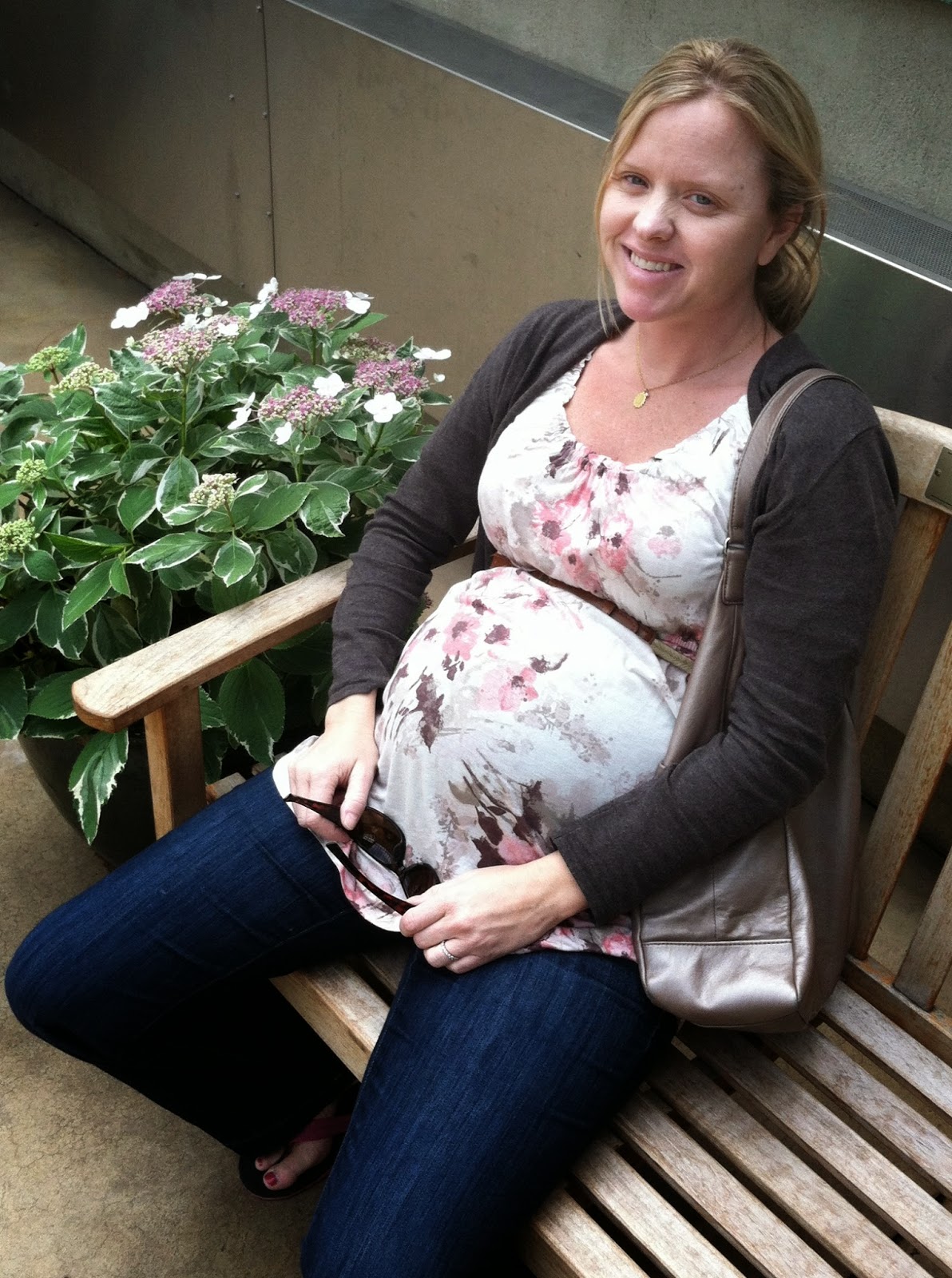
Pregnant with Owen (Sorry, no pics of the current bump)
It's because of him that I'm doing the whole pregnancy thing again. I knew it would be tough, even though everyone says, "Every pregnancy is different." But I wanted him to have a sibling. I wanted to round out our family. I wanted to have another little person around that I loved as much as him. I heard a quote the other day that having a child is like having your heart run around in another person. Blame it on the pregnancy hormones, but when I heard that during a radio interview, I teared up and cried.

The other day Dave and I watched the movie, "Gravity," the space odyssey starring Sandra Bullock and George Clooney. When it first came out I didn't have much interest in seeing it. I'm not one for sci-fi and outer space. I don't care how good the special effects are or how many times Dave tries to tell me a movie is "critically acclaimed," I'm not interested if there's no human interest story to draw me in. But then my friend Erin told me that it was about much more than an accident in space. She said Sandra Bullock's character goes through an emotional journey and suddenly I was in.

If you haven't seen the movie but plan to, then stop reading right here, because I'm about to give away a major plot point. Halfway through the movie you find out that Sandra Bullock's character is not just a scientist up in space, but a mother grieving the loss of her 4-year-old daughter who died in a freak accident. The rest of the movie is not just a story of survival, but of choosing life despite the heartbreak, despite the seemingly unbearable pain. As the credits rolled, I sat on our couch and cried.

"What's going on, babe?" Dave asked gently.

"If anything ever happened to Owen, I would just die," I sobbed.

It's something I've heard my mom say about me and my brother. And until I had my own child, never completely understood.

"I know," Dave said quietly. "I know."

Being a parent makes you vulnerable. For me, that starts in pregnancy. The nausea, the headaches, the fatigue, the crabbiness, the dry heaves, the shortness of breath and all the anxiety. During my first trimester I caught Owen in our bathroom standing over the toilet pretending to spit into it over and over again. Our nanny saw him doing the same thing and we both came to the same conclusion: he was imitating me throwing up. It was one of the cutest things I'd ever seen and for a moment, I smiled, feeling a little less green.

One thing I've noticed during this pregnancy is that I've gained a new understanding of acceptance. During my pregnancy with Owen, I was so blindsided by how terrible I felt and how long it lasted (way into my second trimester), that I just struggled to make it through. During this pregnancy I find myself forging a new relationship with discomfort, the intensity of which fluctuates from day to day. These days, as my belly gets bigger and pushes my internal organs into pancakes, the discomfort tends to be indigestion and feeling like I can barely breathe. Sometimes it's so intense that all I can do is choke down a peanut butter sandwich for dinner and go straight to bed. Other days I feel fine and it's not so bad.

On one particularly nauseating day a few weeks ago, Dave picked me up from work. We drove home together and parked in our space in the alley behind our apartment building and started walking toward the front.

"Maybe there is something to learning to live with a discomfort," I told him as we walked single file on the path along the side of our house.

Dave stopped and looked at me.

"That is something I never thought I'd hear you say," he said.

He says that because I'm a fighter, someone who thinks that if you remain quiet in the face of injustice, no matter how small, you let the bad guys win. You're telling the world, "Hey world, I'm a doormat, come walk all over me, hurt me and treat me however you want." Thus, I've spent much of my life being the outspoken one, the one who clenches her fists and marches down the hallway to speak to the man in charge. The one who complains loudly about the smallest of physical or emotional pain.

Over the years I've heard that the quickest, easiest way to get through difficulty is to accept it. Feel the anger, sit with the sadness, embrace the fear. But that is so much easier said than done. And I've always secretly worried that by doing so, accepting things as they are instead of how I think they should be, I'm endorsing whatever is happening. That I'm saying it's okay. That I'm left with sighing and shrugging my shoulders and saying, "Nothing we can do about it. That's just the way it is."

Nothing is farther from the truth. Acceptance doesn't make me a victim of circumstances, it allows me to see more clearly what is happening, experience what is going on. It's not a matter or liking or disliking it, but seeing it for what it is, then deciding how to respond. I know this sounds awfully Buddhist of me and I'll admit, much of this thinking is the result of mindfulness classes I've taken, meditation exercises I've been doing and a Wednesday night women's group I regularly attend.

Today I still feel the heartburn, the lack of oxygen and the tightness in my chest. I still complain (a little) and blow up at those I love (but less and less). But I also feel an underlying calmness, a greater willingness to say, "Okay, I feel like shit today, so what?" Then go about my day. It helps that this is a temporary state, that it will all be over soon. Did I mention I only have seven more weeks?

Despite my knowledge of that time frame, I know there will be many more discomforts even after the pregnancy, because that's a part of life. I'm so glad that I've finally stopped fighting so much, not just for my well-being, but for the benefit of my kids.

January 13, 2014

Twirling towards happiness

Yesterday Dave, Owen and I were in the living room playing. Dave was sitting on the floor propped up on his elbows with his legs splayed and I was sitting cross-legged on the couch. In between us, Owen was twirling in circles with his arms straight out, then lurching side to side trying to regain his balance. I reached out to steady him and keep him from falling. He giggled at his dizziness, then started twirling again. 

"Have you ever been to a Grateful Dead concert?" I asked Dave. "He reminds me of the spinners."

"No, but I've been to a Phish concert, which is basically the same," Dave said. "Probably even more drugs."

"I doubt it," I said, thinking of how out of my mind I was at a Grateful Dead concert I'd attended in Las Vegas with two sorority sisters during college.

Owen stopped spinning and started dancing along to one of the children's folk songs on our Pandora playlist. He shuffled his shoulders from side to side and moved his head like he was working out a kink in his neck. He's been doing this a lot lately, spontaneously breaking into dance whenever he hears music, even the electronic tunes that play when you push the buttons on his ride-a-long car. Sitting in the seat of his plastic car, he'll look at me as a tune begins to play, smile, and start shuffling his shoulders side to side, like a white boy's overbite.

I love seeing Owen dance, so free and expressive. I've spent one too many dates with men who'd rather be at the bar than on the dance floor, so I hope we can nurture this instinct and help him hold onto it long enough to become a boyfriend and later, husband, who will dance unabashedly with his partner.

Boy joy
As Jane Fonda said so eloquently in a video that recently made the rounds on Facebook, we have to do a better job of raising emotionally literate sons, boys who aren't bifurcated at their heads and hearts — no small feat in a society that will call them "sissies" or "mama's boys" if they show any emotion besides being steady and strong. It's not just crying that will get them in trouble, but playfulness and joy, like the kind you'd let loose on the dance floor. 

"Did your parents ever sit together and play with you like this?" I asked Dave. "I know your dad worked a lot."

"I don't remember," Dave said. "We had a finished basement and I remember spending a lot of time down there with my brothers. I think my parents were pretty exhausted by the time I came around."

"Yeah, I don't remember my parents playing together with me either," I said. "I remember my dad roughhousing with Eric and me on the living room floor but my mom was off doing something in the other room, probably glad for the break. I'm sure my mom played peek-a-boo and stuff with us as babies but then my dad would be at work."

"I have a hard time remembering anything from when I was really little," Dave said. "It's all kind of blurry. One of my first memories was being at the Kennedy Space Center but I don't remember how old I was."

Owen stopped dancing and hurled himself at Dave, grabbing a wad of his hair, another one of his recently acquired hobbies.

"Ow!" Dave said. "Soft touches, buddy, soft touches."

"Owen, let go!" I said sternly. "Let go!"

Owen looked at me, smiling and looking just a little uncertain as he maintained his death grip on Dave's hair.

"Owen, that hurts daddy, let go!" I repeated, as Dave peeled off Owen's fingers and finally broke free. 

Owen lunged at Dave again, who caught him at the waist and hoisted him up in the air out of reach from his head. Owen giggled as he dangled above Dave. Dave set him down on his feet and Owen ran over to me on the couch, his arms outstretched. I folded him into my lap and kissed his winter-chapped cheek.

"Hi, baby," I said, stroking his hair and feeling something sticky, like yogurt, above his right ear. Sometimes Owen pushes my hand away when I stroke his hair or rub his back or legs. This time he didn't.

"I mean, it makes sense that parents would mostly play with their kids one-on-one, because it gives the other parent a break," I continued to Dave. "But I think he really likes it when we're both here together."

"Yeah, he does seem to like it," Dave said.

Sitting there bookending Owen as he ping ponged back and forth between us, I felt happy watching him twirl and shoulder shuffle and yes, even pull hair. I couldn't help but think that we were providing him the kind of safe space and security that was enabling him to be silly and free, knowing that mom and dad were right there.

Maybe I was projecting my own sense of security in that moment onto him. Who knows? I'm just grateful that sometimes, amid the stress of juggling daily life and parenting, I get a glimpse of the true meaning of family. It can make you feel a little dizzy, but there are always plenty of hands to keep you from falling down.

December 10, 2013

Santa's lap: A story in five pictures

This holiday season we engaged in the time-honored tradition of forcing our child to sit on a stranger's lap. Not just any stranger, but a stranger with a long, scraggly beard, beady eyes framed by wire-rimmed glasses, a pillow strapped to his mid-section and spiked eggnog on his breath. Now don't be scared!

I don't know why we didn't impose this ritual on Owen last year, when he was 6 months old and much more likely to scream his head off. The only reason I can think of is that we spent last Christmas with my family in Los Angeles, where the North Pole seems much farther away than Chicago. It reminds me of a scene from "Annie Hall," when Woody Allen and Diane Keaton are driving through the sun-baked, palm tree-lined streets of L.A. in December in their friend, Rob's convertible, while visiting from Brooklyn. As they pass by plastic Santa and reindeer ornaments on the houses' clean, manicured lawns, Woody Allen's character remarks that it doesn't feel like Christmas and that Santa would never come to Southern California because surely "he'd get sunstroke."

So yeah, maybe Santa had stayed away.

But this year we spent the first weekend of December celebrating Dave's parents 40th wedding anniversary at the Wisconsin Dells, where it was 14 degrees outside, but at least 84 degrees inside the steamy, domed water park where we spent most of our time. Just walking around, I could taste the hot chlorine fumes in the back of my throat.

The Wisconsin Dells are kid-friendly, to say the least. So of course Santa was there. When we introduced Owen to him during visiting hours in the hotel lobby, I was struck by how his reaction was so typical of how he approaches all new situations, a personality trait I've watched emerge since he was really little. Here goes:

Stage 1: The blank stare


When Owen encounters a new environment or person, his first reaction is to get quiet, look around and stare. Never do his eyes looks so serious or so brown. He doesn't smile on cue or high-five like strangers wish he would. At least, not right off the bat. He is a person who, as my former NJ roommate Lori would say, "you have to earn." And I like that about him. He's willing to jump into the deep end of the pool, but first he needs to take it all in.

Stage 2: The quivering chin


The first sign that Owen has surveyed a new situation and found it disconcerting is that his chin starts to quiver. It's the same look he gets when I take him into the toddler room at day care, where we are in the process of transitioning him to after spending four days a week with a nanny. He looks at the tiny furniture and the other tiny people reading board books and playing with cars and looks at me like, "No, no, this was not our deal." It breaks my heart every time and I leave wiping away my own tears. The teachers tell me he recovers his composure just minutes after I'm gone and joins right in at Circle Time. I have to believe that's true.

Stage 3: Wait, who are you again?  


One of the best things about Owen is that he's curious, which often means he'll give things a second chance. It also means that I spend my days trying to get him to stop pulling plugs in and out of electrical outlets, grabbing knives from the counter top or trying to stick his hand in the oven. Even when he's throwing a tantrum, I've noticed that it's not long before something will distract him, whether it's a kid playing with a toy nearby or a dog walking by. I try not to force a distraction on him, but wait for his natural instincts to kick in. 

Stage 4: Okay, maybe this is just a little fun. 


As Owen starts to feel more comfortable, his eyes brighten and I can see the edges of his mouth begin to curl up into a knowing smile. I have no idea how much he can really "know" after just 18 months in the world, but it's a knowing smile all the same. He looks at me like, "Mom, I get it. It's all going to be okay." I feel connected to him, like we're sharing a special secret. And that it really is going to be okay.   

Stage 5: Alright, alright, I'll smile.


Once he really feels safe, Owen jumps in with the best of them. He runs as fast as he can, climbs on everything in sight and squeals at the top of his lungs. He claps his hands and does a happy dance. At the water park, his first time being deluged by so much loud, liquid fun, I swear he drank half the pool going down the slides over and over again and sticking his face in the bubblers as tall as him. He'd sputter, gasp for breath, give me a knowing smile, a gleeful squeal and do it all over again.